







 Back to Overview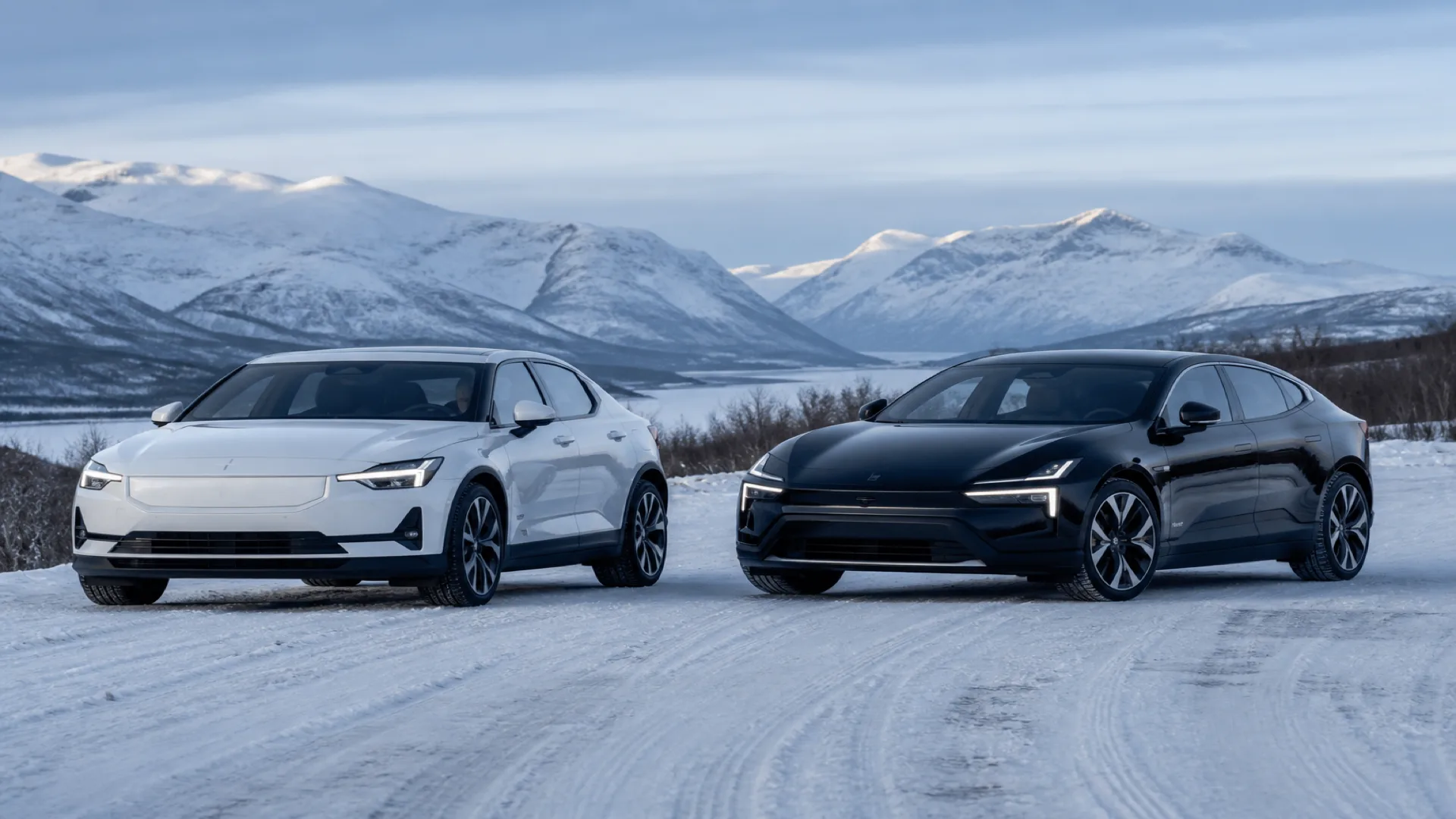
Published on Apr 8, 2026 by Philipp Hellmayr — 4 min read
Who loses more winter range—the Polestar 4 or the Polestar 2?
Key Takeaway
Data from nearly 14,000 trips shows that while the Polestar 4 consumes more energy overall due to its size, it handles winter better, suffering only a 19.6% efficiency drop compared to the Polestar 2's 27.4% penalty. Despite its larger 100 kWh battery, the Polestar 4 offers almost no range advantage over the Polestar 2 in freezing temperatures (303 km vs. 298 km).
Every EV manufacturer quotes an optimistic WLTP range figure. But what does your car actually deliver in January at freezing temperatures versus a mild September afternoon? For Polestar 2 owners considering an upgrade to the new Polestar 4, the question is even more specific: Does the larger, heavier SUV-coupe suffer a harsher winter penalty than the compact fastback?
To find out, we didn't look at spec sheets or controlled laboratory tests. We looked at the ground truth.
The Data Source
This analysis is based on 13,954 real-world trips recorded by Aximote users between September 2025 and April 2026. Because Aximote reads native CAN-Bus telemetry directly from the Android Automotive OS (AAOS), these figures represent actual energy consumed from the battery, mapped against the exact outside temperature recorded by the vehicle during each trip.
- Polestar 2: 11,252 trips
- Polestar 4: 2,702 trips
The data is clear: Both vehicles experience a significant efficiency drop in winter, but the Polestar 4 actually handles the cold slightly better than the Polestar 2 in relative terms, despite being heavier and having a larger frontal area.
However, because the Polestar 4 has a higher baseline consumption to begin with, it still uses more absolute energy per kilometer than the Polestar 2, regardless of the season.
Efficiency by Temperature: The Real-World Numbers
| Metric | Polestar 2 | Polestar 4 | Difference |
|---|---|---|---|
| Warm Baseline (Sep, ~18°C) | 20.2 kWh/100km | 23.2 kWh/100km | PS4 uses 14.6% more |
| Cold Peak (Jan, ~0°C to 6°C) | 25.8 kWh/100km | 27.7 kWh/100km | PS4 uses 7.5% more |
| Winter Penalty (Relative) | +27.4% | +19.6% | |
| Energy added per 1°C drop | +0.33 kWh/100km | +0.47 kWh/100km |
(Note: The January average temperature for Polestar 4 trips in our dataset was slightly milder (6.5°C) than for Polestar 2 trips (0.4°C), which slightly flatters the PS4's peak winter number. However, our temperature-normalized regression model confirms the trend.)
Why do the numbers look like this?
Let's break down the physics and the engineering.
The Baseline Gap In mild weather (around 18°C to 20°C), the Polestar 4 consumes about 14.6% more energy than the Polestar 2 (23.2 vs 20.2 kWh/100km). This makes perfect sense. The Polestar 4 weighs roughly 2,230 kg compared to the Polestar 2's 2,015 kg [1]. Furthermore, the Polestar 4 is wider and taller, resulting in a larger frontal area that requires more energy to push through the air at highway speeds.
The Winter Convergence As temperatures drop toward freezing, an interesting phenomenon occurs: the efficiency gap between the two cars narrows. By January, the Polestar 4 is only consuming about 7.5% more energy than the Polestar 2.
Why does the Polestar 2 suffer a 27.4% winter penalty while the Polestar 4 only suffers a ~20% penalty?
The answer likely lies in thermal management. Heating a cabin from 0°C to 21°C requires a massive amount of energy [2]. While both vehicles utilize heat pumps to scavenge ambient heat and warm the cabin efficiently, the Polestar 4 benefits from a newer, potentially more optimized thermal architecture. Additionally, the Polestar 4's larger 100 kWh battery pack has more thermal mass; once it reaches optimal operating temperature, it may be easier to keep warm than the Polestar 2's 82 kWh pack.
What This Means for Your Range
Efficiency (kWh/100km) is only half the equation; battery size dictates how far you can actually drive.
If we apply our temperature-normalized data to the usable battery capacities of both Long Range models (approx. 78 kWh for PS2 and 94 kWh for PS4), here is the real-world range you can expect:
- At a mild 20°C: The Polestar 2 will achieve roughly 398 km, while the Polestar 4 will reach 435 km. (A 37 km advantage for the PS4).
- At a freezing 0°C: The Polestar 2 drops to 298 km, while the Polestar 4 drops to 303 km. (Only a 5 km advantage for the PS4).
In deep winter, the Polestar 4's larger battery is almost entirely offset by its higher absolute consumption, resulting in virtually identical highway range to the Polestar 2.
Compare two vehicles live
Want to see how another pairing stacks up—or stress-test the same contrast with fresh fleet data? We have launched the Aximote Vehicle Comparison Tool so you can put two vehicles side by side on the same metrics, straight from real trips in our dataset.
Compare Polestar 2 vs. Polestar 4
References
[1] DriveDuel. "Polestar 4 vs Polestar 2 comparison - differences, prices & technical data."
[2] AAA. "How Cold Weather Affects EV Range and Performance."
Written by


See how winter affects your EV in the real world
Aximote records every trip with real outside temperature, energy use, and efficiency from your car—so you can compare mild days with freezing commutes instead of relying on brochure range figures.