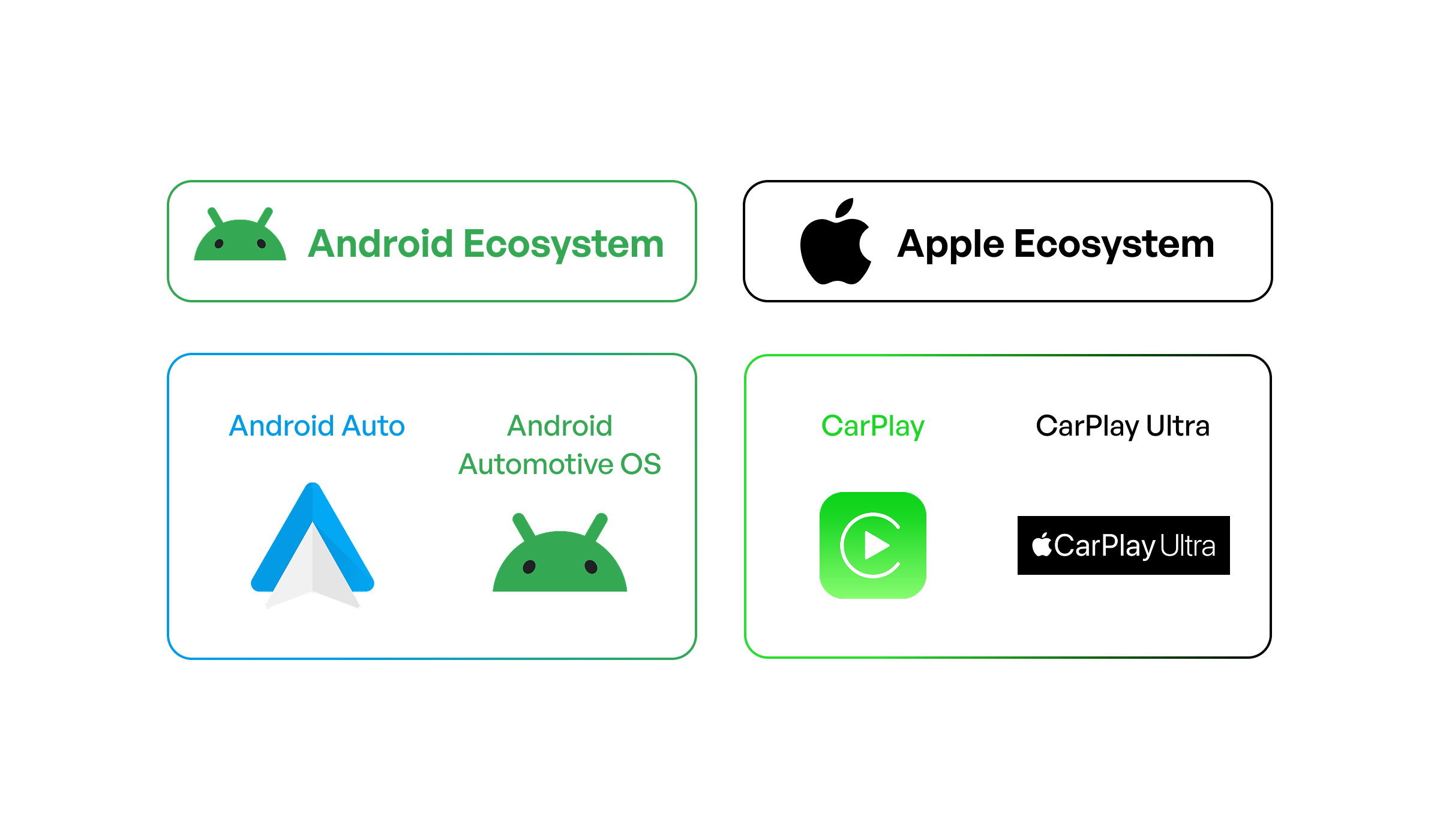
Android Automotive OS vs Android Auto vs Apple CarPlay
The car has changed dramatically in recent years: from a pure hardware product to a digital platform on wheels. Big tech companies such as Google, Apple and NVIDIA are increasingly pushing into the automotive market because the car is no longer just a means of transport, but is becoming a central digital experience space.
Nevertheless, it is still difficult to speak of a holistic digital experience today. The reality is often that most drivers still get into their cars, connect their smartphones via USB to use apps such as Spotify or Google Maps on the vehicle display.
But that is changing. More and more car manufacturers (OEMs) are going beyond classic 'smartphone mirroring' and focusing on native integration. These are systems in which the infotainment runs directly in the vehicle, is deeply connected to the vehicle systems and intelligently links data such as climate control, battery and navigation.
But what exactly is Android Automotive OS, and how does it differ from Android Auto, Apple CarPlay and Apple CarPlay Ultra?
1. Android Auto – Smartphone mirroring for the car
Android Auto is Google's original smartphone mirroring system. It was developed to bring selected apps from your mobile phone to your vehicle's display (e.g. navigation, music, telephony or messaging).
The smartphone is connected to the vehicle via USB or Bluetooth. The display in the car then shows a specially adapted user interface that can be operated by touch, steering wheel buttons or voice control.
Advantages:
- Easy to get started: Many cars support Android Auto ex works.
- Familiar apps: Google Maps, Spotify, WhatsApp and others work right away.
- Always up to date: Updates come via your smartphone.
Disadvantages:
- Dependence on your smartphone: No system without a mobile phone.
- Limited integration: No control of vehicle functions.
- Uniform design: Every car looks the same on the display – no brand identity.
The number of supported apps is growing steadily. Developers can provide new apps for media, navigation or communication via the Android for Cars App Library. Nevertheless, Android Auto remains an extension of the mobile phone and is not a standalone operating system.
2. The systems in comparison
| System | Developer | Runs on | Integration | Connection | App Ecosystem |
|---|---|---|---|---|---|
| Android Auto | Smartphone | Projection to vehicle display | USB / Bluetooth | Android Auto Apps | |
| Android Automotive OS (AAOS) | Built into vehicle | Deep vehicle integration | Integrated | Native vehicle apps | |
| Apple CarPlay | Apple | iPhone | Projection to vehicle display | USB / Bluetooth | CarPlay-compatible iOS apps |
| Apple CarPlay Ultra | Apple | Built into vehicle | Fully integrated system | Integrated | iOS apps + native integration |
3. Android Automotive OS (AAOS) – The complete operating system in the vehicle
Android Automotive OS (AAOS) is not a mirroring system, but a fully-fledged operating system that runs directly on the vehicle's hardware. This turns the car into a standalone Android device.
AAOS is deeply embedded in the vehicle architecture. It can directly control vehicle-specific functions such as air conditioning, seat heating, energy consumption and navigation.
This makes Google Maps, for example, significantly smarter than in Android Auto:
- It uses vehicle data (e.g. battery level) for route planning
- Intelligently suggests charging stops or petrol stations
- Can display information on multiple screens simultaneously (e.g. driver and passenger displays)
OEMs such as Volvo, Polestar, Renault, VW, BMW and many more rely on AAOS. A key advantage is that, despite being based on Android, manufacturers retain their own design DNA. Volvo infotainment still looks like Volvo, only smarter. This is made possible by OEM templates and UI frameworks that allow manufacturers to overlay their own styles on the Android framework.
This makes AAOS one of the most important future systems in the automotive sector. It offers seamless integration without a smartphone, full design freedom for manufacturers and a growing ecosystem of native apps, over-the-air updates and optional Google services (GAS).
👉 Further reading: Android Automotive explained – Why the operating system is rethinking the car
4. Apple CarPlay – iOS mirroring for iPhone users
Apple CarPlay is the counterpart to Android Auto and works on the same principle: the smartphone is connected and a special iOS interface is mirrored on the vehicle display.
The connection is made via USB or Bluetooth. Familiar iOS apps such as Apple Maps, Music, Podcasts and News then appear in the familiar CarPlay design. Control is intuitive and is carried out via the touchscreen, steering wheel buttons or the Siri voice assistant.
Advantages:
- Seamlessly integrated into the Apple ecosystem
- Familiar iOS experience: icons, voice control, operating logic as on the iPhone
- Data protection and security: Apple emphasises privacy as a core brand value
Disadvantages:
- Limited integration: CarPlay remains a smartphone mirror
- No access to vehicle functions
- Uniform appearance: OEMs have little influence on design
Overall, CarPlay offers a comfortable, stable experience for iPhone users. However, it remains an extension of the smartphone – not part of the vehicle software.
5. Apple CarPlay Ultra – Apple's vision of a fully integrated cockpit
With CarPlay Ultra, Apple is taking a similar approach to Google with AAOS, but even more consistently. Instead of just mirroring the smartphone, CarPlay Ultra takes over the entire user interface of the vehicle.
What's new:
- Multiple displays: CarPlay Ultra can display content on all screens in the car, from the instrument cluster to the passenger screen
- Deep vehicle integration: Access to data such as speed, fuel level and climate control
- Uniform design: Apple determines the look and feel
CarPlay Ultra is currently only available in a few Aston Martin models in the US and Canada. Other OEMs are showing interest, but many are hesitant because CarPlay Ultra means losing part of their brand identity. While AAOS allows for customisation, Apple takes complete control of the design.
6. Conclusion: Android Automotive OS prevails – CarPlay becomes an option
Android Automotive OS has established itself as the operating system in cars and, according to Gartner, will be installed in over 80% of new cars by 2028. Many vehicles with AAOS continue to support Apple CarPlay, but it now only runs as an app on Google's platform.
The crucial question is therefore no longer whether CarPlay is available, but how often drivers still use it when the native system has long since offered everything integrated. For companies like Aximote, this shift offers enormous innovation potential: The combination of AAOS, data-driven services and scalable architecture enables new forms of mobility intelligence – directly in the vehicle.